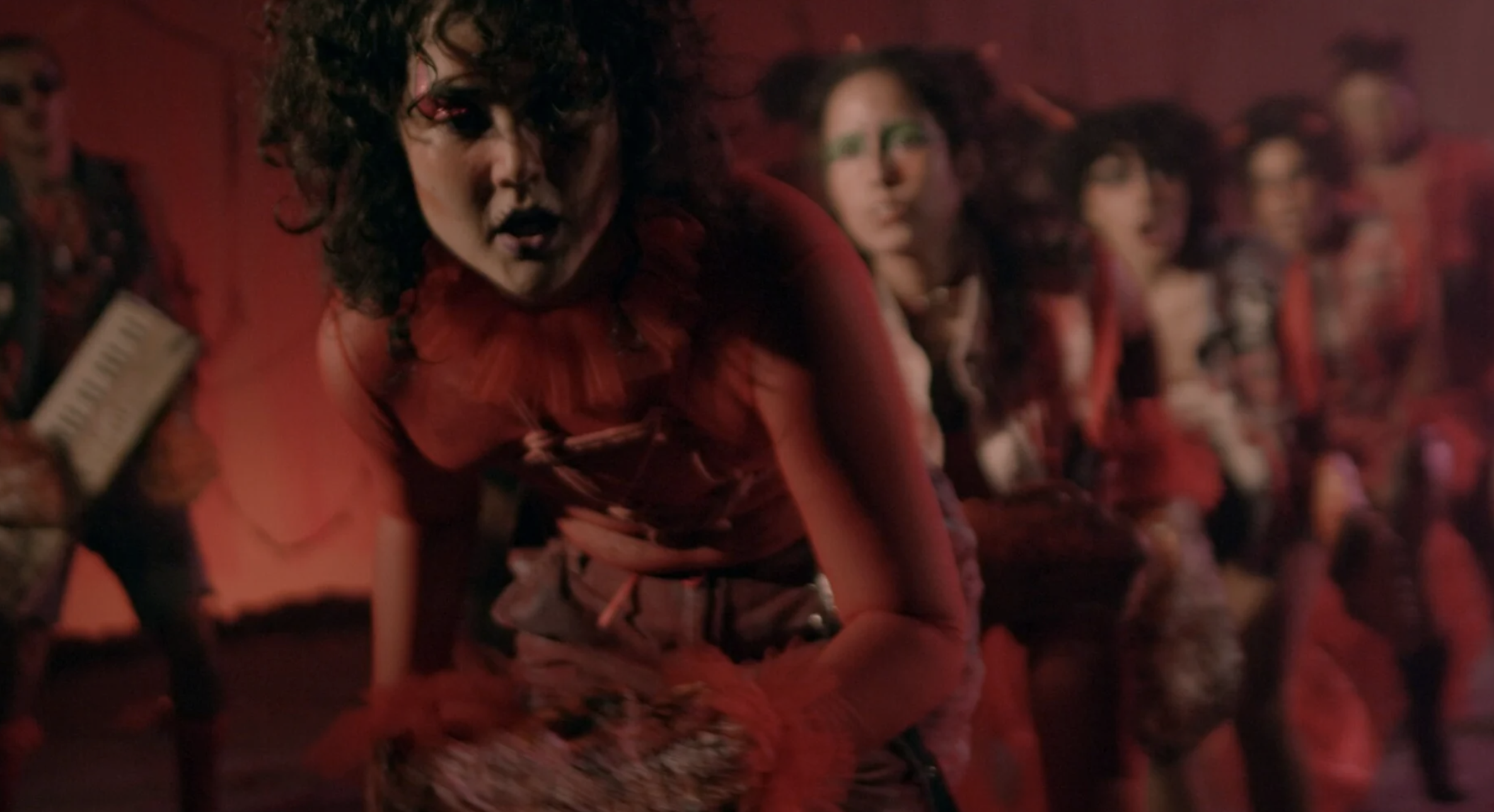

Screening as part of Imbolg: Women Who Terrify Film Festival, A Lobster Named Desire is a surreal, grotesque short from Panama that follows Conchita. This lively, spirited girl, is invited to her favourite restaurant by Renzo who intends to propose marriage. Writer Holly Buckley spoke to directors Sol Moreno and Risseth Yángüez Singh about the film’s origins, their collaborative process, surreal symbolism, and what it means to screen their work at the festival.
Can you tell us how this film came to be and where the original idea came from?
Sol: A friend told us a somewhat grotesque story just to pass the time: a girl masturbated with a lobster that deposited eggs inside her, making her terribly ill. As he told it, images and colours started forming in my mind, like a playful mise-en-scène. I commented that I’d like to make a film out of the story, and Risseth said she was in. At that moment I was feeling a bit discouraged about cinema; I had a script that wasn’t moving forward, so I set it aside to work on this more unhinged story. But the story kept mutating, adding a punk musical element and a narrative of mental liberation that I think has much more to do with myself than with the original story.
Risseth: Yes, we were hanging out with a friend and he started talking about something he had read in a creepy pasta or something like that, we thought it was quite funny and absurd, then Sol told me about the idea and I wanted to jump in. As Sol said, the story kept mutating, it started as some doodles and printed pictures with the shots in our notebooks to what it is now.
How did this collaboration happen, and how did you co-direct the film while maintaining such a specific and unique vision?
Sol: Risseth and I come from different worlds: I come from punk, comics, absurd and trash cinema; Risseth is a conceptual artist and documentarian. We started syncing through watching a lot of films that shared common ground with the story—films like Pepi, Luci, Bom y otras chicas del montón, Antibirth, Eraserhead, Bad Biology, The Lure, or Cecil B. Demented. We did several sessions and always tried to stay as faithful as possible to the script. Compared to other films I’ve made, this one is the most faithful to the script.
Risseth: At that time I thought it was the opportunity to do something that was completely different to what I used to do as I was a bit overwhelmed with my documentary and the process, this seemed like the opportunity to get on board something that I could do with friends that I admire, have fun and fall in love with making movies again. Sol knows a lot about this type of cinema so she made a list of the movies to watch and then we would take screenshots of the specific shots that we liked. I delved into Sol’s world, honestly, this wouldn’t have come out the way it did without her vision, it was a learning experience and it still is.
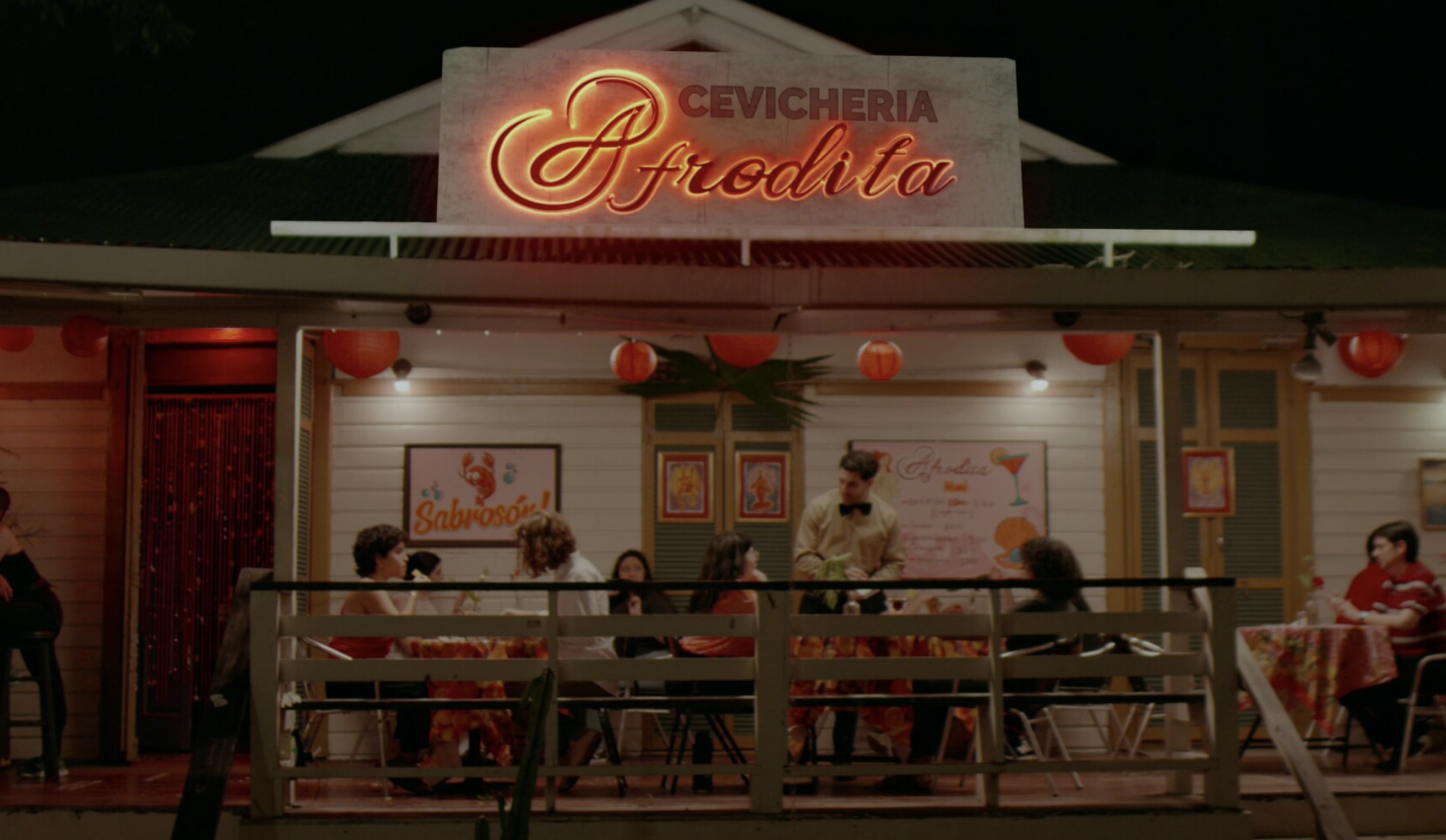
Your cinematography and production design are striking. The red and highly stylised interiors really reminded me of early Almodóvar and Italian giallo films. What inspired this visual feast and how long did it take to shoot?
Sol: Yes, films like ¿Qué he hecho yo para merecer esto? by Almodóvar were among the references we shared with Milko to develop a proposal for Conchita’s house. This film also speaks, in part, about obsessions, and we wanted Conchita to be the one most obsessed with lobsters, which is why red is so present and dominates everything. I also once heard that Tovoli, in Suspiria, covered walls with red velvet to intensify the color. I think the use of textiles suggested by Milko, to make up for the lack of materials like silicone or latex due to budget limitations, further reinforced that intention. The shoot took six days, but the construction of the sets took much longer. We had a lot of artist friends volunteering for several weeks to help build the sets and the costumes.
The act of intimacy with the lobster almost feels like a metaphor for Conchita merging with desire itself and entering a space of personal liberation and surreal power. How did you approach filming these sequences, and what does the lobster symbolise for you?
Sol: On my end, I needed that surreal and absurd world in the film as a counterpoint to the shitty reality we’re moving through. That scene was shot in a single day, with a lot of takes; we didn’t have enough budget to stretch it any further. We also built a kind of diorama for the lobster, lobster-sized, to complement the act and give it a sort of poetic magic. The lobster, like Sibilo, functions as a kind of oracle in the face of the void in Conchita’s life: the answer isn’t out there, it’s inside you.
Risseth: Like Sol said, the surrealism and the absurd was very important for it to work. I think Conchita’s world is a place where she only cares about eating lobster but also about her freedom to do whatever she wants. When she has her moment with the lobster, it's the ultimate act that can happen with this obsession and with this relentless desire that she carries but at the end, it can only be bearable inside of her because the outside world is still as shitty as always.
Indigenous folklore is a rich source for horror. How did Panamanian cultural elements, folklore influence your film?
Sol: I wouldn’t say that Indigenous folklore is a rich resource for horror. The creatures and spirits that appear in its worldview are, for the most part, protectors of nature; it’s when they are syncretized with Catholicism that they take on a more terrifying reading. However, the short film focuses on marking a sense of tropicality specific to Panama, which is more evident in the Afrodita restaurant and in the music that accompanies Conchita, composed by Jordi, with whom I’ve been working for many years. More than anything, it was a way of situating the “real” part of the film in a specific place in the world: the place where we live.
Risseth: The most influenced it had, in this sense, was the Panamanian tropicality, we cannot escape it, everything we do reeks of the heat, abundant colours, the tropical forest and the culture that melts out of it. But as Sol said, it is only for the “real” parts of the film, the restaurant and her house also, although her house is maybe more alternative it still has elements and colours that situates the audience in this environment. Most importantly is the music in these scenarios, Jordi already had a clear idea of the music, we shared some references and from there he made up the songs that accompany these scenes with some friends helping with the chorus.
How did you approach gender and power in telling this story from a female lens?
Sol: We are women; our perspective is always female. I feel that the short film, even though it starts from a silly idea, does carry a statement of self-affirmation in a society that constantly expects things from women and from their work. The intention was always clear: we’re not going to follow imposed lines, we’re going to do whatever we feel like doing, and we found in the absurd and the surreal the tools to make that happen.
Risseth: I think the approach was always to do something completely out of the ordinary and have fun while doing it. As women, sometimes we are expected to do or create things that are more “lady-like”, not grotesque or even “respectable” to society. This was the opportunity for us to say fuck it and do the absurd, without any restrains and have fun while doing it. I’m not a fan of the word feminine, because for me it is a synonym of what I said earlier, we created this from our own necessity of breaking that mold and to that I’m always grateful.
How does it feel to be part of the Imbolg Women Who Terrify Film Festival, which foregrounds women’s storytelling?
Sol: It’s the first time the short film is being shown outside of Panama, so it brings a mix of anxiety and excitement to have unfamiliar eyes seeing our creature. Still, I feel that a festival like Imbolg, dedicated to horror and fantasy short films made by women, is like the perfect sea where our lobster can truly belong.
Risseth: It is very exciting that the first film festival that it entered is one like this. I think this reaffirms the approach we had at the very beginning and gives us a boost to continue applying to film festivals that like weird and absurd film from this side of the world.
Finally, can you tell us what you’re working on next, and where readers can stay in touch with you and your work?
Sol: On one hand, we’re planning to develop Una Langosta Llamada Deseo into a feature film, and on the other, I’d like to return to a script I had set aside, The Heat, another grotesque story about menopause. You can find my work as a filmmaker and visual artist on my IG @armadillowwwoman666; you can also check out the website of Cine Tamborito, our main production company: https://cinetamborito.com/
Risseth: I'm currently working to finish my feature length documentary about the afro Panamanian history that has a very intimate and personal point of view. I also have two fiction short films that are still in the writing process about racist experiences that had happened to me as a black woman in Panama in a more Jordan Peele kind of way. You can follow my work on instagram: @rissethyanguezsingh
Thank you so much for chatting with us!
A Lobster Named Desire is screening in Strand One at Imbolg: Women Who Terrify Film Festival. Read more about the festival here, see the full shorts lineup here, or get your tickets here.
Sol Moreno
Panamanian Visual artist and filmmaker, defender of DIY and counterculture as an immediate form of communication. She edits fanzines, makes video art, music videos, and films like El Martillo de las Brujas. A lifelong horror fan, she entered Barcelona’s underground horror scene in 2006, collaborating on projects and festivals, and shooting experimental films and several shorts.
She plays bass and screams in lo-fi garage bands. She’s the co-creator of the Panama Fantastic and Horror Film Festival. She has done underground graphic curating. As an artist, she has had three solo shows in Panama and Mexico, participated in group exhibitions, and served as a juror at Latin American horror film festivals. Diablo Rojo is her first feature film: it premiered commercially in Panama in September 2019 and then toured more than 30 festivals including Mórbido, Buenos Aires Rojo Sangre, and Fantaspoa. She’s currently working to turn Una Langosta llama Deseo into a feature, developing her new project El sofoco, and a visual series titled Casas en llamas.
Risseth Yángüez Singh
Infiltrated in the world of contemporary art, Risseth Yangüez Singh works with archives, the body, and the gut. She is interested in colonial texts, untold stories, and the possibilities of the body and her hair, from the most absurd to the most profound. She is part of the production company Mente Publica and collaborates with the Panalandia Film Festival. She is currently in post-production on her first feature-length documentary called Cuscú.